


News 7 minutes min read | 06-03-2026
CSB celebrates 10 years of discovery, collaboration, and impact

“Together, there is no limit to what we can discover.”
Those 10 words, stated by United States Senator Dick Durbin, inspired a roaring ovation of applause from attendees at the Northwestern University Center for Synthetic Biology’s 10-Year Anniversary celebration Wednesday.
The statement, delivered in a prerecorded message from the Illinois Senator and longtime supporter of the Center for Synthetic Biology (CSB), encapsulated synthetic biology’s promise and potential. It summarized why the CSB was first established in 2016 and hinted at the limitless future of the Center and its trainees.
“One of the most important investments we can make as a nation in our future is in medical and scientific research,” Sen. Durbin said. “If we want to find treatments and cures for diseases, develop the technology of the future, then we have to empower our researchers to take risks and innovate. That mission guided the creation of the Center and its researchers continue to push the boundaries of discovery every single day.”
Looking back at the history of the CSB
Wednesday’s celebration welcomed current students and faculty associated with the CSB, as well as industry leaders to the Woman’s Club of Evanston to reflect on the past, present, and future of synthetic biology. Attendees learned about the origin of the CSB, dating back to 2008 and the hiring of five core researchers: Josh Leonard, Michael Jewett, Keith Tyo, Neda Bagheri, and Milan Mrksich.
Former McCormick School of Engineering Dean Julio Ottino spoke about recognizing “a signal” about the potential of these researchers.
“I put them in front of others across McCormick, across the University,” Ottino said. “We were not presenting a finished vision. We were testing, watching where there was interest, where there was friction, where conversations extended beyond initial meetings.”
The CSB officially launched on March 22, 2016, with Mrksich as the founding director and Jewett the founding co-director. Jewett, now a Professor of Bioengineering and Chemical Engineering (by courtesy) at Stanford, looked back at the Center’s origin and its subsequent growth and impact.
He acknowledged Ottino’s encouragement to share what synthetic biology was — and what it could be — for helping the CSB gain early traction and interest.
“Leadership from above within the institution enabled the Center to be cultivated,” Jewett said. “This has really been critical to the success of the Center.”
To date, the CSB has:
- $50+ million in funding
- 49,000+ collective citations (more than 40,000 in the past five years)
- 80+ patents and patent applications
- 200+ community events
- 700+ trainees
“Ten years ago when we were just getting started … we had ambitious plans and great visions for how the center would grow,” said Mrksich, who was unable to attend but shared a recorded message. “Looking at our Center today, 10 years later, I think what we’ve done exceeded even our ambitious visions.”
Capturing the moment
While it is important to understand how the CSB and synthetic biology as a whole got to where it is today, a key theme throughout the festivities was looking forward to how the field — and the CSB — can shape lives moving forward.
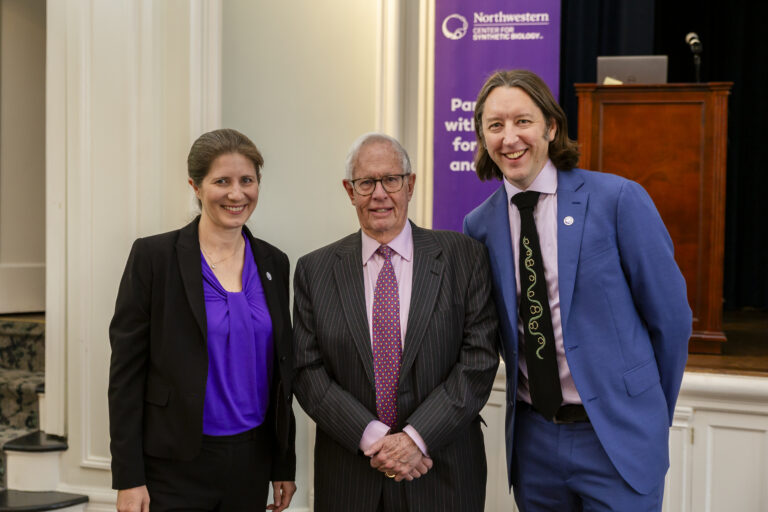
“The anniversary marks not only a decade of the Center’s growth and achievement, but also a period of transformation for synthetic biology as a discipline,” said Northwestern Interim President Henry Bienen. “Synthetic biology has evolved from a largely exploratory idea into a set of technologies that increasingly touch our everyday lives.”
Christopher Voigt, the Head of the Department of Biological Engineering at Massachusetts Institute of Technology, delivered the day’s keynote address. Voigt discussed his lab’s focus on experimental and theoretical models for genetic engineering for applications in agriculture and mining.
He also talked about the strong connection between MIT and Northwestern dating back to the founding of the CSB.
“We’ve hired your former students as faculty, you’ve hired our former students as faculty,” he said. “We co-founded many things in the field. Moving forward, I think this is a tradition … that we’re only going to see accelerate more deeply.”
Dario Robleto also spoke about acceleration. Robleto spent five years as Artist-at-Large at the McCormick School of Engineering and Northwestern’s Block Museum of Art, where he explored the intersection of art, technology, and ethics in society.
He sees this time period as a transformative moment for the field of synthetic biology.
“Your field is fascinating because it is young,” Robleto said. “Almost every hope and fear is still part of the question. It hasn’t yet had enough time to know where the story’s heading in its grand scheme, and the potential benefits and the future harms of your field are really staggering.”
To help capture the moment, Robleto recorded interviews with attendees about their feelings on synthetic biology: where has it already succeeded, where has it missed the mark, and how will it shape humanity in the future.
The collection of interviews will serve as a time capsule for the CSB.
“The public understands that your decisions today might impact their wellbeing in the future as well as their loved ones,” Robleto said. “It’s unclear which paths this field is going to take over the next century or two centuries, and that makes this a really interesting moment to document.”
Continuing to look forward
The CSB continues to think about future possibilities for synthetic biology, and Wednesday featured a variety of new efforts to help shape that future.
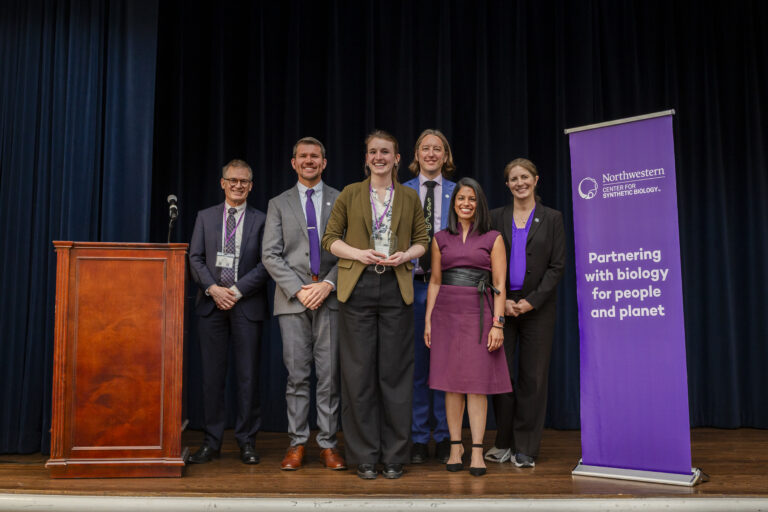
The CSB presented the inaugural distinguished trainee awards to four current trainees:
- Distinguished Trainee Award Postdoc Co-Winner: Nitu Kumari (Goyal Lab)
“Decoding Cell State and Cell Fate Decisions”
- Distinguished Trainee Award Postdoc Co-Winner: Rachel Mizenko, PhD (Kamat & Leonard Labs)
“Developing a trans-amplifying RNA reporter assay for sensitive detection of protein delivery by lipid-based nanocarriers”
- Distinguished Trainee Award Graduate Student Winner: Daniel de Castro Assumpção (Tullman-Ercek Lab)
“Reaching the Liver, and the Liver only: A Targeted Nanodelivery Strategy” - Distinguished Trainee Award Graduate Student Runner-Up: Dylan Brown (Lucks Lab)
“ExpandingCell-Free Biosensor Platforms Through Automation, Materials, and New Targets”
CSB co-directors Julius Lucks and Danielle Tullman-Ercek announced the formation of the Center’s first Executive Advisory Board. The Board includes:
- Melih Z. Keyman (Board Chair) – President and CEO at Keytrade AG
- Ena Chan Cratsenburg – Chief Business Officer at Ginkgo Bioworks
- Jeff Fairman – Vice President of Research and Co-Founder at Vaxcyte
- John S. Frels – Vice President for Research and Development at Abbott Diagnostics
- Jose Carlos Garcia-Garcia – Senior Director, Research Fellow, and Head of Corporate Biotechnology at Procter & Gamble
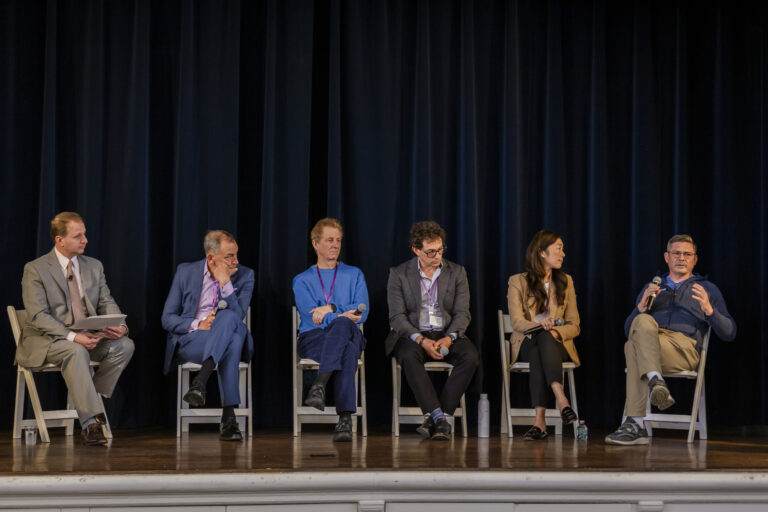
Keyman, Cratsenburg, Fairman, and Garcia-Garcia were joined by Voigt on Wednesday for a panel discussion about the future of synthetic biology. The conversation was moderated by Christopher Schuh, Dean of the McCormick School of Engineering.
“The CSB is doing a fantastic job under the leadership of Julius and Danielle,” Garcia-Garcia said. “We’re here because we’re betting on their success and we want to be part of it.”
Lucks and Tullman-Ercek also announced that they, along with eight other CSB colleagues, are writing a textbook (published by Oxford University Press) focused on teaching synthetic biology and engineering biology across scales.
Additionally, the co-directors announced a new collaboration with the Querrey Simpson Institute for Regenerative Engineering and the Querrey Simpson Institute for Bioelectronics to launch the Living Electronics Initiative at Northwestern.
“The possibilities are truly endless for the CSB,” Tullman-Ercek said. “In 10 short years, we have gone from the seed of an idea to a thriving community.”
Lucks agreed.
“One of our greatest products is the people that come out of this Center,” he said. “Probably the most exciting thing that’s happened over 10 years is the creation and the nurturing of this wonderful community.”
Story by Marc Zarefsky
Photography by Vanessa Bly