


Uncategorized 7 minutes min read | 09-15-2026
Students Present Research at Annual CSB Symposium

Anica Diaz never ran her own independent research project before this summer. Now, after three months of being focused on her own project through Northwestern University’s Center for Synthetic Biology (CSB), she’s able to share not just the results, but the impact of the opportunity.
Diaz and 22 other students from across the country were paired with a research lab at Northwestern for the summer. On Friday, August 14, they presented their research to classmates, faculty, staff, and invited guests at the annual CSB summer research symposium.
“While it is one thing to carry out experiments that others have already outlined and thought through, the fellowship has offered me the freedom to design my own experiments, navigate unexpected challenges, and make decisions about the trajectory of my research,” Diaz said. “Through this experience, I have developed an entirely new skill set, both in experimental design and in metacognition. I have become more intentional in why I run an experiment, what I can learn from the results, and how those results should influence my next steps.”
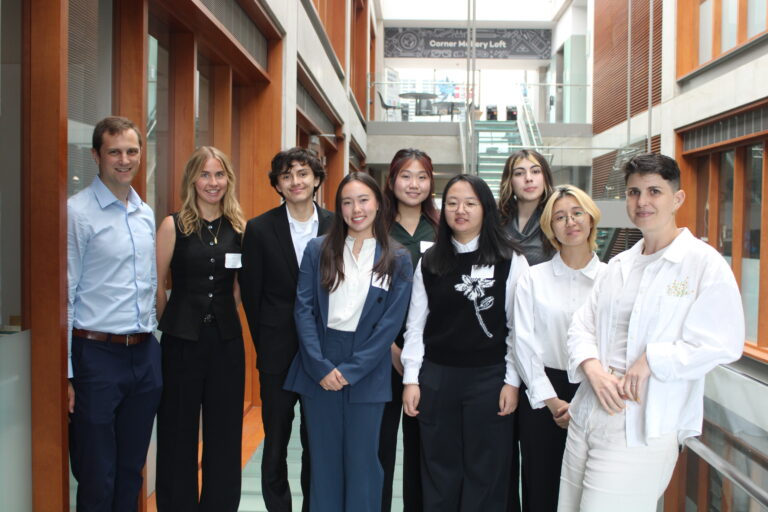
Diaz was one of seven Northwestern undergraduates to participate in the summer research program thanks to the DeFeo Family Undergraduate Research Fellowship in Synthetic Biology—a two-year program supported by the Ron and Andrea DeFeo Family Foundation. These fellows explore the intersection of biology, chemistry, math, and engineering through sustained research, specialized coursework, workshops and site visits to local biotech startups and research centers.
“The discipline of asking questions that lead to new discoveries or adapt existing technologies to new, important applications will be critical to the success of their careers,” said Eric DeFeo, Treasurer of the Ron and Andrea DeFeo Family Foundation. “By working with a cohort of their peers under the mentorship of exceptional faculty and graduate students, I believe these students can gain more perspective on the world beyond the lab and classroom.”
Candace Tebbenkamp, program director for science innovation at the Walder Foundation, agreed.
“The symposium is about more than presenting research, it’s about helping students find their voice as scientists,” Tebbenkamp said. “By sharing their work, responding to questions, and engaging with fellow researchers, students build the confidence, communication skills, and sense of belonging that are essential to a successful career in science.”
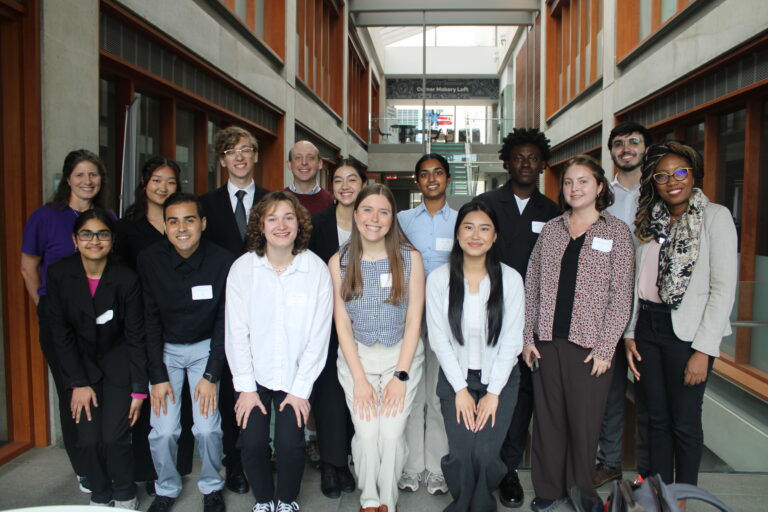
Twelve of the symposium presenters were participants in the Synthetic Biology Research Experience for Undergraduates (SynBREU) program. Thanks to support from the National Science Foundation and Walder Foundation, these students spent 9-10 weeks at Northwestern to develop practical laboratory skills, gain exposure to advanced synthetic biology techniques, and engage in interdisciplinary activities aimed at strengthening their communication, ethics, design thinking, and entrepreneurial mindsets.
“The SynBREU program was truly an eye-opening introduction to the possibilities of research in synthetic biology,” said David De Leon, an undergraduate at Austin Community College. “The program reaffirmed my interest in research and helped me develop the mindset of a scientist. I learned how to think critically, and how I may be able to improve my experiments for future work.”
This year’s summer research students also included four students from the Army Educational Outreach Program (AEOP).
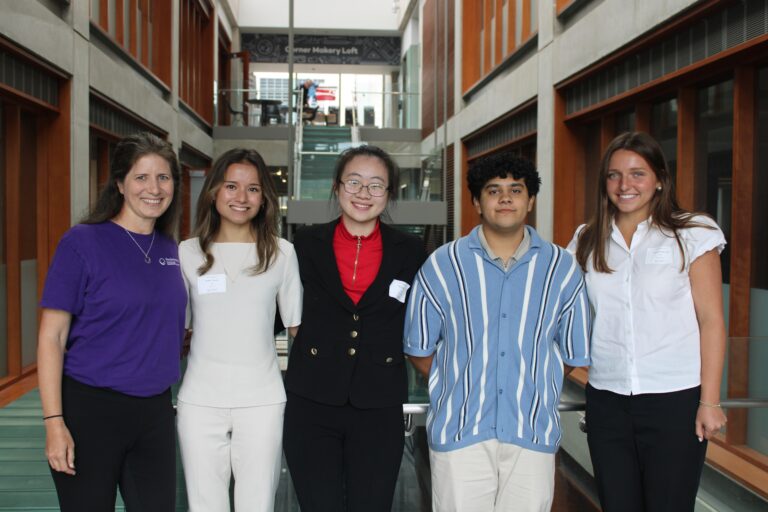
“The summer has been awesome, I’ve really loved this opportunity,” said Robyn Davies, one of the AEOP students. “Everyone has been so welcoming. It’s been particularly awesome to see how a lab gathers behind you. I’ve had help from so many people beyond my mentor during this program.”
In addition to the student presenters, the undergraduate research symposium featured a lunchtime conversation with Eric DeFeo, moderated by CSB faculty member and Northwestern associate professor Erica Hartmann.
“Synthetic biology is a relatively new discipline with unimaginable potential,” DeFeo said. “Northwestern has established a program and community that will create the leaders who shape this future.”
2026 CSB Symposium Participants
Below is the list of this year’s SynBREU, DeFeo Fellowship, Walder, and AEOP participants, along with their home institutions, host Northwestern labs, and project titles.
SynBREU Program Participants:
- Alexia Joseph | CUNY Hunter College | Rocklin | Predicting Protein-Peptide Interactions utilizing Stability Prediction Models, SaProtΔG and ESM3ΔG
- Camryn Bir | Ohio State University | Broadbelt | Leveraging and Refining Computer-Aided Synthesis Planning Tools for Medicine and Sustainability Applications
- David (Davy) Platt | University of Colorado Boulder | Lucks | Towards Structural Mechanisms of Tetracycline Aptazymes: Interrogating Communication Module Dynamics via In Vitro Cleavage Assays and Chemical Probing
- David De Leon | Austin Community College | Rivnay | Understanding Distance Effects on Electrogenetic Cell Activation and Viability Within a Stimulation Platform
- Israel Josh Tioua Ponpou | Rose Hulman Institute of Technology | Tullman-Ercek | Impact of codon usage on MS2 virus-like particle morphology
- Kumiko Muro | St. Olaf College | Aristilde | Metabolic Flux Analyses of Pseudomonas putida Variants Grown on Lignocellulose Substrates
- Larissa Firmansyah | California Polytechnic State University, San Luis Obispo | Prindle | Investigating the role of bacilysin shunt-products during sporulation programming in Bacillus subtilis biofilms
- Luis Garay-Colón | University of Puerto Rico Cayey | Volpatti | Decoupling Fab targeting of LDL from IL10-mediated uptake using Fab-mScarlet fusion proteins
- Maya Hruskar | Smith College | Leonard | Exploring methods of gene expression control for improving production of CAR T Cell therapies
- Mia Hamaguchi | Wellesley College | Mrksich | Engineering IL-21 to overcome T-cell exhaustion
- Paloma Carignano | University of Georgia | Karim | Characterizing the metal-binding capacity of Lanpepsy homologs
- Shrika Venkateshwaran | Mount Holyoke College | Hartmann | Systematic Identification of Host Defense Systems against DMS3 Infection Across Diverse Pseudomonas aeruginosa Strains
DeFeo Fellows
- Anica Diaz | Northwestern | Karim | Cell-Free Production and Optimization of Antimicrobial Peptides Targeting Gram-Negative Bacteria
- Ching-Tung (Angie) Lee | Northwestern | Shrinivas | Computational Design of Thermoresponsive Proteins
- Jose Flores | Northwestern | Kamat | Lipid Nanoparticles for Selective Gene Delivery in Treatment of AAA
- Kaylen Ng | Northwestern | Leonard | Characterization of genomically integrated zinc-finger binding arrays in mammalian cells
- Kiera Kurt | Northwestern | Hartmann | Identifying Pseudomonas aeruginosa Phage p007 Receptor Using a Transposon Insertion Library
- Sydney Papke | Northwestern | Tyo | Characterizing and Engineering a Split Enzyme Biosensor
- Yuhan (Hannah) Zhang | Northwestern | Goyal | Optimality of the genetic code under a robustness–expansion tradeoff
AEOP Program Participants
- Alexian Heynez | Waubonsee Community College | Kamat | Investigating Membrane Biophysical Properties in Lymphatic endothelial cells (LECs) as a model system for glaucoma
- Harper Hasbrook | New Trier Township High School | Gianneschi | Enhancing Brain Delivery of Proteomimetic Polymers
- Marlina Wu | Walter Payton College Prep — NOTE: Marlina recently graduated HS and is an incoming NU freshman | Tullman-Ercek | Evaluating the Relationship Between Mutations on the Self-Assembly of PduA Materials
- Robyn Davies | Phillips Exeter Academy (PEA); Mary Institute and Saint Louis Country Day School (MICDS) — NOTE: Robyn recently graduated HS and is an incoming NU freshman | Lucks | Engineering Protein-Based and RNA-Based Biosensors for Water Quality Monitoring
Story written by Marc Zarefsky