


News Staff 6 minutes min read | 12-04-2025
CSB Staff Profile: Behind the Numbers—A Conversation with CSB Business Administrator Brianna Bullock

We recently spoke with Brianna Bullock, the Center for Synthetic Biology’s (CSB) Business Administrator, about her path to Northwestern, her day-to-day work, and her interests in East Asian culture, language learning, crafting and more.
What are your current job responsibilities?
As the business administrator for CSB, I handle a lot of our financial operations and do a myriad of things under that umbrella. The bulk of my effort is in pre- and post-award management, helping the faculty set up their budgets for grant proposals, managing awards and gifts, tracking budget allocations, processing transactions, and making corrections when needed. There is never a dull day!
What does your typical day look like?
It’s honestly, never the same. My typical day starts off with emails and triage, then moves to one-off requests and expense approvals. I also check in with our budget, balances, and projects and set priorities for the day. For the budget pieces, I’m updating trackers, running reports, analyzing those reports and communicating balances to faculty. We’ve got quite a few grant proposals going out and some new awards coming in as well.
How has the current budget climate affected your job?
We’re just trying to be a lot more cognizant of how we’re spending on our grants and keeping faculty informed. One of the biggest impacts that I’ve seen is with the recent government shutdown. We were working on a $20 million dollar proposal and wanted to ask the sponsor a couple of questions, but we weren’t able to because of the shutdown.
What traits are important in your job?
It’s important to listen. Faculty have very different work styles, so it’s important to understand and adapt to those.
Tell us more about your background and what drew you to work in higher education?
I graduated from the University of Chicago with a degree that’s totally different from what I’m doing right now—I studied East Asian languages and civilization and computer science. My first position out of college was working with the Biomedical Engineering Department at Northwestern—it was largely for event planning and event coordination.
After working at Northwestern for a bit after I graduated, I eventually left for position in South Korea where I taught English for three years. To be in the culture that I studied so much in college was fun and immersive. It was my first adult experience living off on my own and it really shaped me to be the person I am now.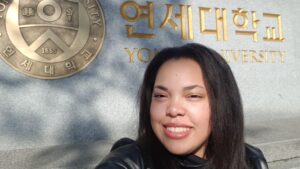
When transitioning back to the US, I connected with an old colleague who let me know about a position with the Mrksich Group as a program assistant. I applied and was fortunate to be hired. Eventually, I was promoted to program coordinator and assumed some of the post-award management processes for the group. That role prepared me for my current position.
How have you utilized your computer science experience?
Early in my position here at Northwestern, I participated in a coding boot camp. I was able to take the skills I learned in bootcamp and develop a whole new website for the Mrksich Group that contained several interesting functions that, at the time, we had not seen on other faculty websites. They are still using the site today. I’m also often the go-to person for AV and tech support in our group.
Other than English, what other languages do you speak?
I’m most fluent in Korean. I have studied Spanish, Chinese, and Japanese.
Where did your interest in languages come from?
As a child, I grew up super interested in East Asian culture. I was always listening to Japanese music and watching anime. I learned about Korean music in college, and that led me to study Korean. I had an 8 AM Japanese class and a 9 A.M Korean class. It was actually very fun and kind of cool to do one right after the other because you get a close view of how similar they are—but also how different they are—and can compare the two real time.
What other interests do you have outside of work?
In addition to language learning, I like to craft working with wood and resin. During the pandemic, I bought a 3D resin printer and taught myself how to use it. That led to the filament printer that I’m using today. I’m still learning, but I’ve gotten quite a few projects under my belt now. I hope to use it to create centerpieces for CSB’s 10-year anniversary celebration.
What achievements are you most proud of?
I would say the opportunity to study abroad. Because I was able to do so well in the Korean class at UChicago, I was able to get the opportunity to study abroad during my second year at a top three University in South Korea called Yonsei University. I was there only for a semester but that really drove me to go back. I fell in love with the culture and speaking Korean with natives. It compelled me to study abroad the following year and do an internship in China. I stayed there for the summer and did a multi-East Asian country travel trip—I went from China to Japan to Korea.
What keeps you motivated when things get hard?
I think it’s knowing I have a team backing me and that my effort is just as important as theirs as part of the team dynamic. It’s important for me to keep on top of things so that we can keep things flowing. In addition to my team, it’s my love of cultural learning—I could talk about that forever. It’s always been something I’ve been super interested in and want to work hard so I can keep doing it.
Tell us a fun fact about yourself.
I’m super into singing. Earlier this year I had the opportunity to sing and create my own album in Korea. I got the whole experience of being in a studio. In Seoul, you can reserve a studio, and they will provide you with a tech team and someone who can guide you on warm-ups, editing and vocals. I have a CD!
What advice would you give others who want a career like yours?
It’s important to investigate positions before you jump into them and figure out what the trajectory of those positions are. And, of course, talk with people who have those positions currently. Try to network so you can really get a full grasp of what you’ll be doing. And then, if you’re interested in it, that’s for you—go for it! Just try to make sure that you’ve got the skill set to jump in. And know if you don’t have everything, don’t let that stop you because this is a position where you’re going to be constantly learning and adapting and evolving.
by Lisa La Vallee