


Education News 6 minutes min read | 12-10-2025
Building Community, Shaping the Future: Inside the CSB Trainee Association
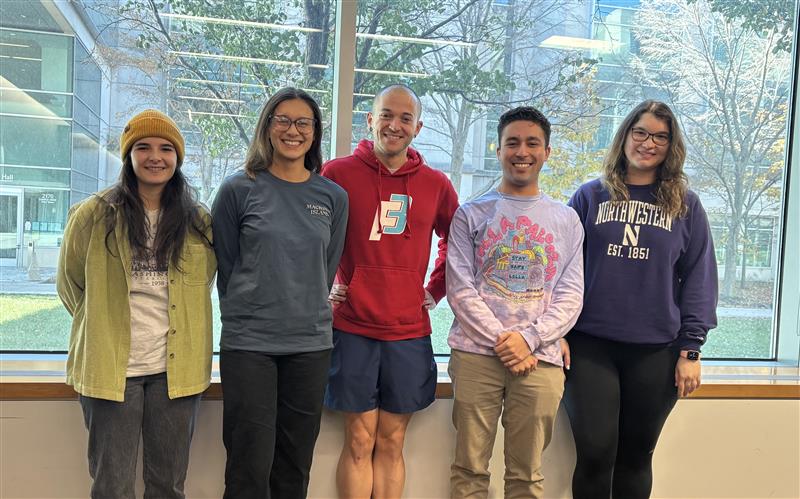
What began in the aftermath of the pandemic as an effort to foster deeper connections among graduate students, postdocs, faculty, and administrators in Northwestern’s Center for Synthetic Biology (CSB) has since evolved into something far more enduring. In 2024, a dedicated group of graduate students formally launched the CSB Trainee Association (CTA)—an organization committed to building community, supporting student research, and helping shape both current and future Center events.
We recently caught up with CTA Board members Mary Skillicorn (3rd-year PhD student, ChBE, Shrinivas Lab), Maddie Joseph (4th-year PhD student, ChBE, Tullman-Ercek & Dunn Labs), Xav Bower (2nd-year PhD student, ChBE, Lucks & Leonard Labs), Matthew Lucia (3rd-year PhD student, ChBE, Tullman-Ercek & Kamat Labs), and Beliz Utebay (3rd-year PhD student, MSE, Rivnay & Kamat Labs)—pictured left to right above—to learn how their interest in synthetic biology first took root and what gives them hope following a challenging year marked by uncertainty in research funding.
 Mary Skillicorn
My inspiration for science is granted mostly to my high school chemistry teacher, Mrs. Ball, where she taught and demonstrated the positive impacts science can have on the world. I wanted to follow this path contributing to a future where essential resources are clean and available for everyone. Deciding on next steps for college, I was amazed by the ‘technology’ (proteins, metabolic pathways, ecosystem, etc.) that biology has already created to be renewable. And, inspired by the scientists who were able to utilize and engineer biological technology into positively impactful tools for society (such as producing biofuel from algae) I studied Chemical and Biological Engineering. Today, I am very happy to be part of the Center of Synthetic biology as everyday I get to contribute and to be inspired by others who share the same goals for a better future.
My hope comes from both the stories of great scientists in the past and the work being done by scientists today. In the past, the curiosity of biology and the intention to use it for the good of humanity, such as CRISPR and mRNA vaccine technology, is motivational enough to keep working – even through challenging times. Looking toward the future, I see countless scientists working hard to understand the biological world more and use that understanding to improve communities’ lives through cleaner water, accessible medicines, and more. From what I’ve seen, this motivation will persist until those goals are achieved—and that gives me hope.
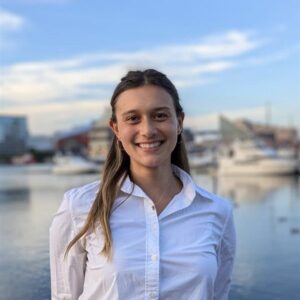 Maddie Joseph
Growing up, I loved animals, from dinosaurs to lemurs. Organisms of all kinds captivate, excite, and delight me. I just think they’re so beautiful! Humans, both knowingly and unknowingly, have been collaborating with other organisms to help us thrive for as long as we’ve existed. Synthetic Biology has allowed me to work alongside a whole new type of organism – bacteria! – to make the things that surround us in our everyday lives more sustainable. Being a trainee at CSB has helped me see the spark of life everywhere, even in microbes, and reminds me not to take it for granted.
There’s a growing recognition that a sustainable future isn’t just about emissions and pollution. I love that I see that mentality here at CSB! As we innovate, we need to think about our impact on communities, cultures, and ways of life. Many individuals and groups here seem very sensitive to that, and I see people asking deep, ethical questions about how their research might work its way into the world all the time.
Xav Bower
I have always thought that biological systems are far more beautiful than those based on physics or chemistry. Working in the molecular diagnostics industry, I saw that next generation sequencing and oligo synthesis had superpowered our ability to read and write the language of biology; I figured it was time to learn how to use that ability to start building those systems from scratch! I applied to the ChBE PhD program at Northwestern hoping to join the CSB and the rest is history.
Despite growing global instability, everyone I know still has gas in the tank to make the world a better place. My family, friends, and colleagues in Chicago and at Northwestern give me hope that through collective effort and mutual support, we can move towards a more equitable, sustainable, and happy future.
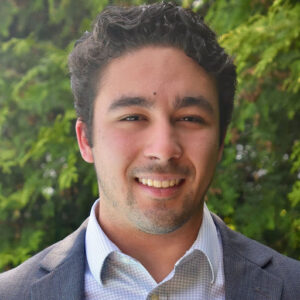 Matthew Lucia
I first became interested in synthetic biology through my undergraduate research, where we studied proteins that could be used to bind and remove heavy metals from solution. I was originally discouraged from pursuing biology, thinking that it required a lot of memorization, something I am not good at. I was surprised when I started conceptualizing and considering how the complex systems that I worked with could be engineered. I was still slightly unsure about continuing to pursue this avenue of research and was doing work in a polymer chemistry lab when I read a seminal paper about degrading plastics using engineered enzymes. Something in my mind clicked where I knew I had to continue pursuing science in the field of synthetic biology, and I haven’t looked back since.
I am so inspired by the passion that the Northwestern scientists have for their work and advancing science for the sake of humankind. So many of my fellow students find ways to better themselves through the myriad programs that Northwestern offers, mostly to broaden the scope that their research can impact. I regularly interact with so many students who love doing outreach and talking to local community members about the work that they do to give back to the local community as best as they can.
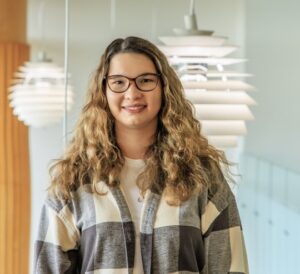 Beliz Utebay
The idea of engineering the smallest unit of life and/or its components and potentially advancing medicine has fascinated me since middle school. Thus, I decided to pursue my PhD in a field where I can explore synthetic biology, as well as its integration with different materials to develop more functional applications. On this note, being a part of CSB allowed me to connect with incredible researchers in this field and gain valuable knowledge that I had been seeking.
The dedication of researchers here at Northwestern, including my colleagues and myself, gives me hope for how we can continue advancing each and every single field. There are so many research areas related to synthetic biology, and seeing everyone work with such passion to bring solutions to existing problems brings me hope and optimism every day.