



On January 14, 2026, the Center for Synthetic Biology (CSB) joined other centers and institutes across Northwestern to participate in the Office for Research’s first URIC Research Impact Day. A selection of synthetic biology research on display highlighted several innovative research projects designed to improve human health as well as the environment.
Revolutionizing Farming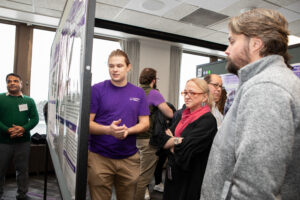
Joey Brogan, an undergraduate and research technician in the Aristilde Research Group, shared a poster about the lab’s SmartSense project that seeks to identify signals released by plants when they are facing hunger or nutrient starvation.
“The idea is to learn what chemical signals are relevant to plant starvation and encapsulate nutrients in a soil compatible material that can recognize the plant’s chemical signals and release the nutrients that are needed,” Brogan says.
The capsules do the work of fertilizing plants only when needed, an idea that not only makes farming more efficient but also eliminates waste and pollution.
“A lot of fertilizer as it is applied today is not actually used. It gets either not taken up by the plants or immediately washed away when it’s watered or it’s raining. So, the idea is to drastically limit the need for purchasing fertilizer on behalf of the farmers. Also, it would eliminate the excess fertilizer that is being released into waterways that causes environmental pollutions,” Brogan said.
Building Next Generation Biosensors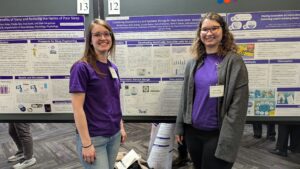
Rachel Mizenko, a postdoctoral fellow in the Leonard Lab, and Beliz Utebay, a third-year PhD student in Material Science and Engineering in the Rivnay Lab and Kamat Lab, demonstrated novel ways to improve human health using synthetic biology.
“We’re trying to integrate electronics with biology in two different ways,” Mizenko said. “We have one project where we’re doing this using synthetic biology and integrating into cells different pathways that involve electrical stimulation and then can produce a therapeutic.”
“In addition to this,” said Utebay, “we try to engineer cell-free-inspired model membranes and we’re trying to incorporate them with native recognition elements of the cells and aid synthetic biologists with bio-inspired tools and sensors for them to test certain chemicals or whatever they want to test.”
Cell-free synthetic biology works by borrowing useful pieces of DNA from living cells and using them outside the cell. The researchers study how cells normally respond to things like reactive oxygen species, then reuse those DNA parts to create new responses. Even though cells don’t naturally do these new tasks, they already have the molecular machinery needed to make them work.
The long-term goal of Mizenko’s research is to create “living pharmacies” where instead of having to do repeat injections, medical providers could implant a device that has cells in it that could produce the drug over time, control it, and give different doses as required.
“We’re at the very leading edge of that and we are hoping we can get little steps towards making these living pharmacies,” Mizenko said.
Enabling Quality Water for Everyone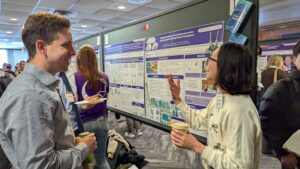
Siyuan (Juliana) Feng, an MD/PhD student in the Lucks Lab, provided an overview of a collaborative effort between the Lucks team and Young Group in CSB, NU Water where Young is the Center Co-Director and Lucks is an affiliated faculty member, the Gaillard Lab in the Department of Civil and Environmental Engineering, and several other groups interested in water at Northwestern, including the Dichtel Research Group in the Department of Chemistry, and Robert Weinstock, who directs the Environmental Advocacy Center at Pritzker Law.
“We’re all passionate about making information about water quality accessible for all people,” Feng said. “The focus of this specific project is on lead, a widespread and dangerous neurotoxin found in legacy infrastructure, and our goal is to develop an at-home lead test that ordinary folks can use and interpret that is also sensitive enough to detect at the FDA threshold for lead in bottled water. We’ve piloted our test with nearly 200 households in Evanston and the Southeast Side of Chicago, and we’ve been excited to find that our tests are working out in the world!”
The team is also investigating how people modify their knowledge, attitudes, and behaviors when they have access to testing.
“The potential impact of this work is broad,” Feng said. “We think that accessible testing will empower individuals to make more informed choices that improve their health, help communities document hazards and advocate with data, and assist policymakers both in triaging and monitoring lead contamination and remediation.”
Top image: CSB staff and researchers at Northwestern’s Office of Research’s URIC Impact Day. Photo credit: Eileen Molony. Photo credits (2 and 4): Eileen Molony (3) Lisa La Vallee.
by Lisa La Vallee